


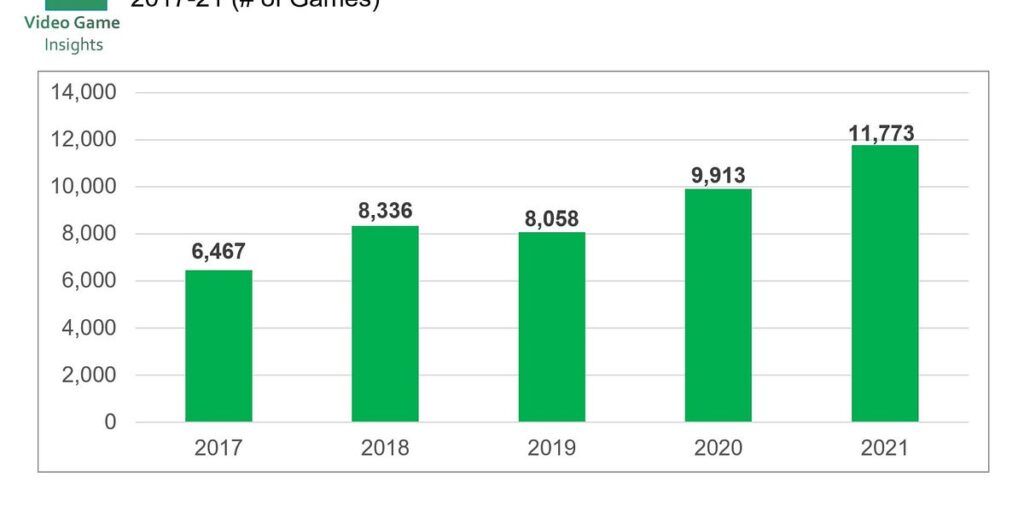
The gaming industry is facing an overwhelming flood of titles, many of which go unnoticed and unplayed. Despite the excitement around new releases and indie projects, this surge reveals deeper issues about sustainability, societal priorities, and the true value of creative effort. As someone who has been immersed in indie game development for decades, I want to shed light on the absurdity of this endless production and its implications for both creators and society at large.
The numbers speak volumes. The chart above tracks the annual release counts on Steam, where the majority of new titles are indie productions. Over the past five years, more than 43,000 games have been launched—that’s roughly 23 new titles each day. In 2021 alone, the daily average jumped to over 30. And this figure doesn’t account for mobile app stores, itch.io projects, or countless homemade games. When you consider these sources, the total number of new games becomes staggering, illustrating a market saturated with effort and ambition.
This relentless influx of new titles raises a critical question: who truly benefits from so many games? The reality is sobering. Despite the billions of people on Earth, most of these games are sold only to the developer’s immediate circle—friends, family, or a handful of niche audiences. Genuine widespread interest remains elusive. If your goal is to make money or to bring joy to others, most of these efforts fall short. Failure isn’t just common; it’s the norm. If you’re content with a handful of players, that’s fine; but it’s worth asking whether your limited time could be better spent on pursuits that genuinely impact society.
This brings us to a stark reality: the proliferation of indie titles is a symptom of misplaced priorities and a societal disconnect from meaningful creation. The market is flooded with products that, while often crafted with dedication, are ultimately unneeded. The sheer volume dilutes value and makes it harder for truly innovative or essential projects to stand out. If your ambition is to craft a game that resonates or benefits the community, consider the broader context. For instance, exploring how to create engaging experiences for small screens can be a meaningful pursuit, but it also reflects the necessity of designing for limited hardware capabilities—something that requires careful planning and skill. You can learn more about this in guides on crafting immersive experiences for small screens.
The industry’s saturation isn’t limited to games alone. We see similar patterns across all creative fields. Spotify releases over 60,000 new songs daily, Amazon publishes millions of books, and countless TV shows, podcasts, and web content flood our digital spaces. The explosion of content is not inherently bad, but it points to a society that values quantity over quality, often at the expense of meaningful progress. Most of this content is consumed in isolation, adding to the fragmentation of our social fabric. Mountains of distraction make it increasingly difficult to focus on what truly matters—building a better world or supporting vital infrastructure.
Who is behind this relentless production? The truth is, it’s often driven by young creators motivated by passion but operating in a landscape where the odds are stacked against them. Many make games knowing the chances of success are slim, yet they persist because creation gives life purpose. Still, the question remains: why produce art or entertainment that nobody wants? Even the most talented developers are aware of the brutal reality—they’re making content for a marketplace that’s overwhelmed and indifferent. The drive to create persists because it fulfills an intrinsic need, not necessarily because it guarantees success or societal benefit.
Creating art and games offers a vital outlet for personal expression and societal contribution. For young people especially, it’s a way to channel energy into positive change. Unfortunately, modern society provides fewer avenues for meaningful engagement. Social institutions have weakened, and many jobs are trivial or disconnected from real societal needs. Without proper outlets, the passion to build and improve can turn into frustration or despair. That’s why so many produce endless streams of content—it’s a small act of rebellion, a way to find purpose amidst chaos. If you feel compelled to develop a game, I support that effort. Just remember, the true value lies in what you contribute to the world, not just in the act of creation itself.
Yet, time and energy are finite resources. Society’s focus on artistic pursuits at the expense of infrastructure, health, and essential services is problematic. For example, cities like Seattle struggle to maintain basic infrastructure—roads, bridges, utilities—while countless hours are spent in pursuit of artistic expression. These are necessary investments that sustain our communities and improve everyday life. If we continue prioritizing fleeting entertainment over essential work, we risk neglecting the foundations of society. Building and maintaining vital systems requires real effort, not just passion projects.
This reality leads to a fundamental question: how do we balance creative pursuits with societal needs? If everyone devotes their energy to making games or content for entertainment, who will take on the crucial roles—fixing roads, ensuring public safety, providing healthcare? It’s a zero-sum game. If the majority focus on producing art that no one consumes or benefits from, we risk neglecting the infrastructures that support us all. Paid work that addresses real needs—like fixing potholes or supporting essential services—may seem less glamorous but is vital. If you haven’t learned how to fix a pothole, perhaps it’s time to consider the importance of such skills.
The proliferation of content is a privilege of wealth. Most of the creators behind these countless games and media are fortunate, often coming from affluent backgrounds that allow them to pursue artistic passions without immediate survival concerns. This abundance is enabled by global capitalism, which supplies cheap labor and mass-produced goods from overseas. These systems sustain the illusion of endless creation but also mask the underlying inequalities and environmental costs. The demand for immediate gratification and distraction feeds this cycle, diverting attention from pressing societal issues. We must ask ourselves: is this endless cycle sustainable? Or are we simply delaying inevitable collapse?
This pattern isn’t exclusive to video games. The same phenomenon occurs across all creative sectors—music, literature, visual arts—and even in broader societal behaviors. The endless flood of content and distraction is a symptom of deeper systemic issues. Society’s focus on superficial entertainment risks overshadowing urgent problems that demand collective effort and real change.
Why do so many produce content despite the overwhelming odds? Creators aren’t naive—they understand the brutal reality of the market. Still, the act of creation serves as a lifeline, a way to find meaning amid chaos. It’s a form of expression that keeps hope alive, even if it contributes to the saturation of unneeded products. The question remains: why continue to produce in such a crowded landscape? The answer lies in human nature—our desire to build, to express, and to leave a mark.
Creating meaningful work is essential for personal fulfillment and societal progress. The drive to improve the world is innate, but modern circumstances often limit those opportunities. Social fragmentation, political disillusionment, and economic pressures make it harder to find outlets for constructive effort. When meaningful avenues are closed, the urge to produce art or entertainment intensifies as a substitute. That’s why the endless stream of new games, songs, and stories persists—each act of creation a small rebellion against societal decline.
However, society’s capacity to sustain such endless production is finite. Infrastructure decays, public services falter, and the environment bears the cost. Developing skills like fixing a pothole or maintaining critical systems is far less glamorous but vital for survival. If society continues prioritizing entertainment over essential work, it risks collapse. Everyone should consider whether they’re contributing to building a sustainable future or merely adding to the noise.
The truth is, much of this abundance stems from privilege. The vast majority of content creators come from wealthy backgrounds that allow them to focus on art without immediate economic pressure. This system is sustained by global inequalities, with cheap labor and mass manufacturing enabling endless content creation. Yet, the real cost is often hidden—environmental degradation, social instability, and resource depletion. If the rest of the world begins demanding fairer prices and better conditions, the current abundance could collapse overnight.
In conclusion, while creating and sharing art is valuable, it must be balanced with the needs of society. The endless production of content is unsustainable if it comes at the expense of infrastructure, health, and the environment. We should recognize the importance of practical skills and societal contributions just as much as artistic pursuits. Only by addressing these priorities can we hope to build a future that’s sustainable and meaningful for everyone.
You can explore more about the costs associated with mobile game development and how to engineer ecosystems that thrive across platforms. Ultimately, the challenge lies in channeling human energy into efforts that genuinely advance society, rather than into endless cycles of distraction and unneeded creation.