
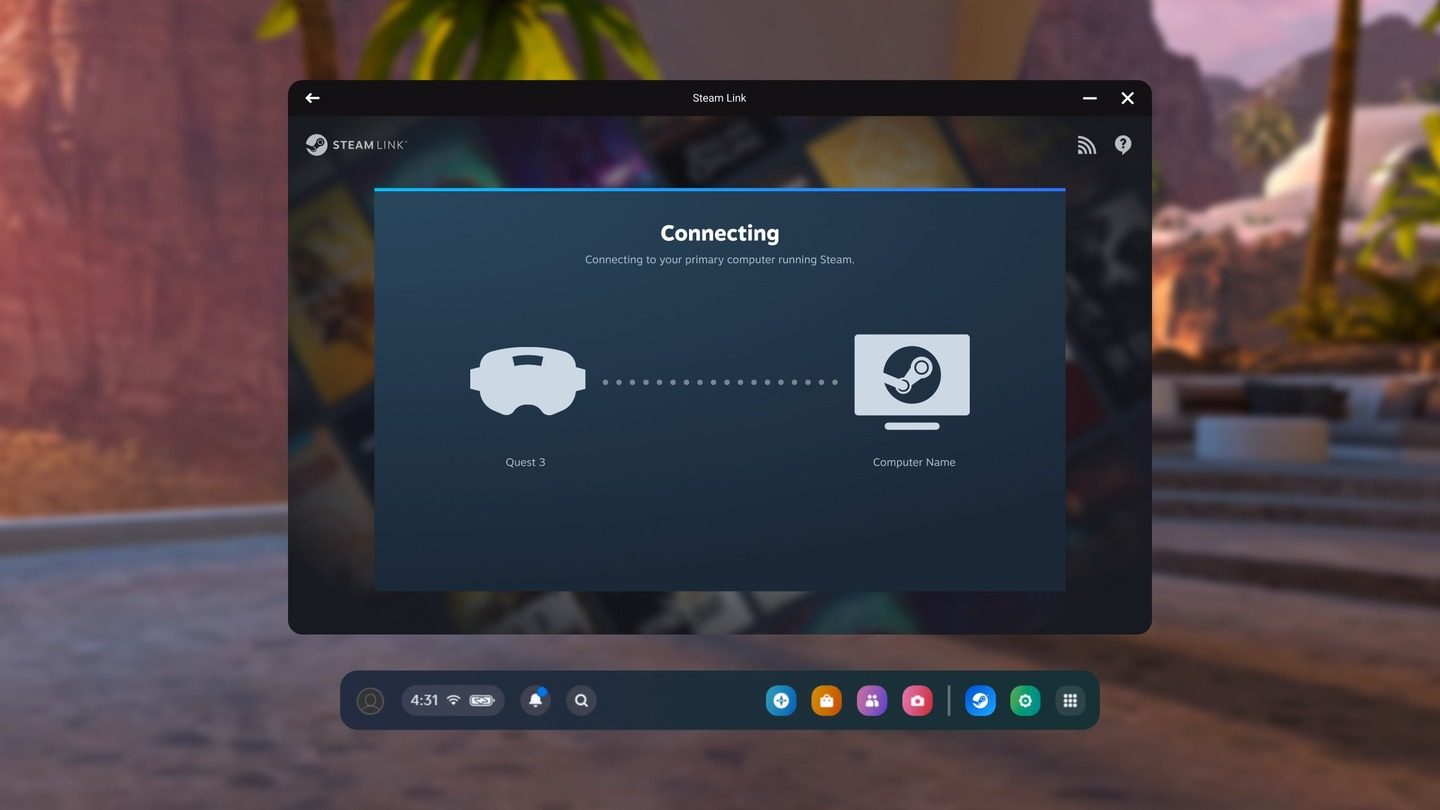
The latest updates to Steam Link for Quest are making a noticeable difference in how VR games appear when streamed wirelessly from a PC. With Quest users now able to enjoy higher quality visuals, the improvements are especially evident for those with powerful gaming rigs, elevating the overall VR experience. Valve’s quick response to user feedback demonstrates their commitment to refining wireless streaming, particularly as they introduce advanced features that enhance visual fidelity.
Thanks to the recent SteamVR Beta 2.2.1 update, Quest owners now benefit from Advanced Supersample Filtering, a feature designed to significantly improve the clarity and sharpness of streamed content at high supersampling rates. This technique involves rendering the scene at a larger resolution than the display’s final output and then downsampling it, which effectively reduces pixelated edges—commonly known as aliasing—and creates smoother visuals. This process is especially valuable in VR, where image quality directly impacts immersion.
Valve notes that, prior to this update, Advanced Supersample Filtering was unintentionally disabled on Meta headsets due to an older change. Now re-enabled, it offers a substantial upgrade for users experiencing subpar video quality without auto settings enabled. While the filtering can demand a robust PC setup to notice a stark difference—particularly in intensive titles like Half-Life: Alyx (2020)—it provides an important tool for enthusiasts seeking the best possible streaming quality.
For those interested in the technical details, the patch includes several updates: enabling 10-bit video encoding on AMD graphics cards (still experimental), improvements to the debug UI, and network stability tweaks to reduce lag caused by stream resets in suboptimal wireless configurations. Additionally, it allows connections to be maintained even without QoS support, broadening compatibility across various network setups. You can review the comprehensive patch notes here.
In the broader VR landscape, the most graphically demanding titles like Asgard’s Wrath 2 and Assassin’s Creed Nexus showcase the potential of current hardware. The upcoming RTX 4070 Ti Super or even the RTX 4070 could be sufficient to run these games at high settings, but much depends on how well the software is optimized and whether developers leverage the full capabilities of the hardware. As VR technology advances, the debate continues over the best ways to balance visual fidelity with performance.
Meanwhile, discussions around the state of PCVR emphasize that many new titles are still in early development stages, often resembling beta versions of what is available on standalone devices like Quest. Some believe that dedicated PCVR hardware could make a comeback if developers manage to port major titles like Horizon or Resident Evil Village—but current restrictions from console manufacturers like Sony hinder such efforts. For insights into how to effectively build or expand a VR team, you can explore strategies for staffing in game development.
The VR community remains divided on the performance of streaming options like Oculus Link, Virtual Desktop, and Steam Link. While Virtual Desktop generally provides the most stable experience, Steam Link’s ability to support 120Hz streaming offers an edge in terms of smoother gameplay, especially on older Quest models. Despite these improvements, issues like foveated encoding—where the resolution drops outside the eye’s focus—still present challenges, particularly with high-resolution headsets like Quest 3. For those interested in optimizing VR performance, understanding how to unlock game genres in VR can help developers and players alike to maximize their gaming horizons.
As VR hardware continues to evolve, the focus shifts toward achieving total immersion through better interaction methods, physics engines, and realistic environments. While titles like Half-Life: Alyx set a high bar for immersion, new experiences like Vertigo 2 and innovative AR applications hint at a promising future. For those eager to explore building their own VR team or scaling their projects, resources like guides on starting an indie game development team are invaluable.
In conclusion, the recent Steam Link updates mark a significant step forward in wireless VR streaming quality, bringing more vivid and detailed visuals to Quest users. As hardware and software continue to improve, the VR community can look forward to richer, more immersive experiences—whether through enhanced streaming techniques, more powerful hardware, or innovative game design.